
Know what the game is actually paying you
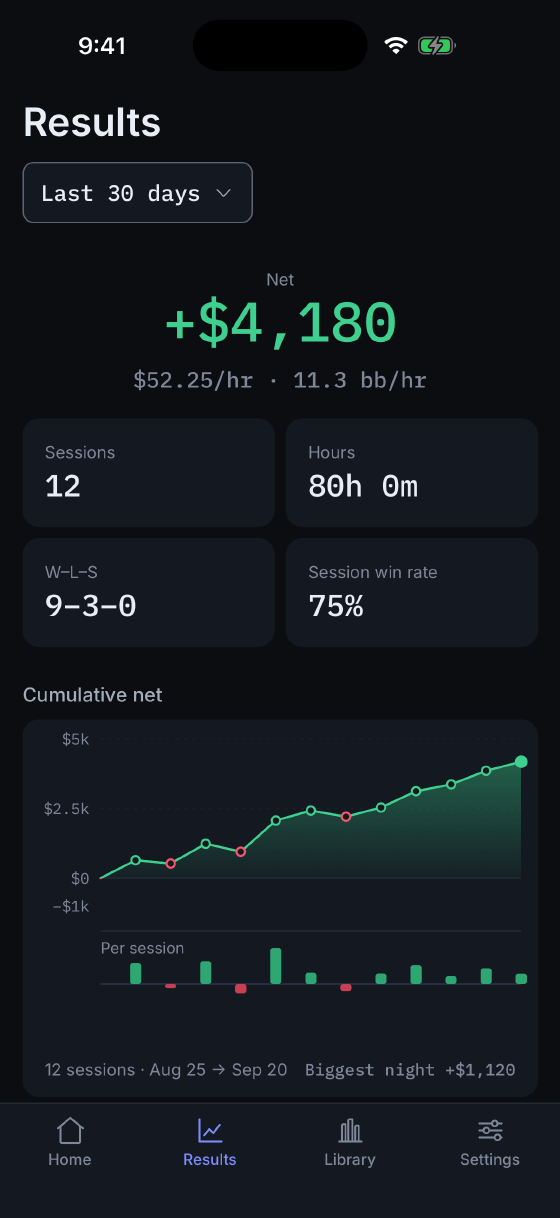
Buy-ins, rebuys, tips and time. Net, $/hour and bb/hour — by room, by stake, and by how long you'd been sitting there.
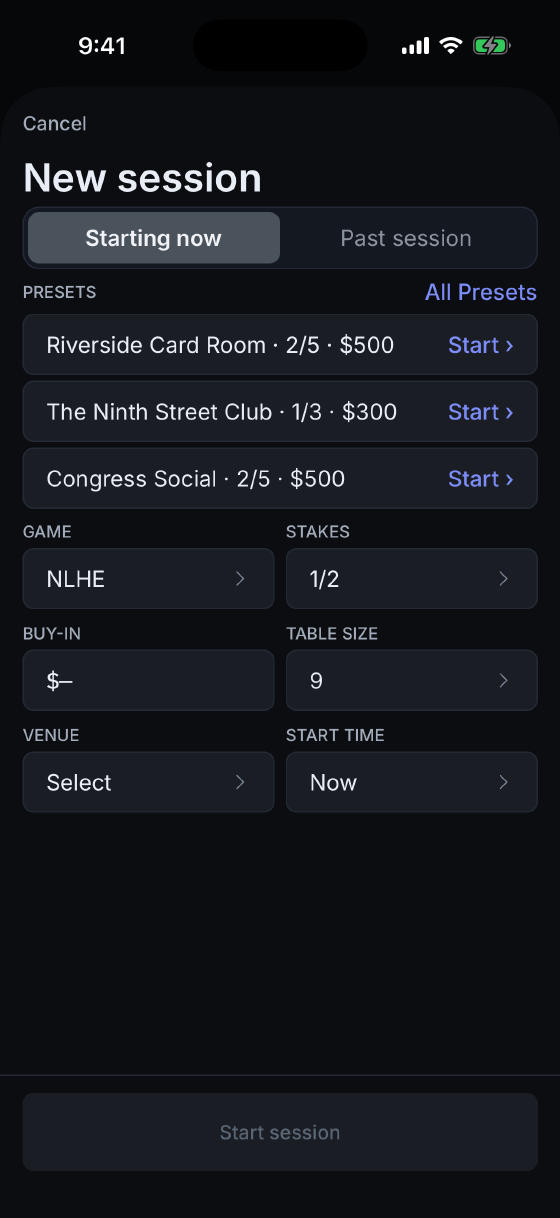
Sitting down takes about ten seconds
- 01
Tap a preset
Your usual game, saved — stakes, buy-in and venue already in. If it's somewhere new, fill them in once and save that too.
- 02
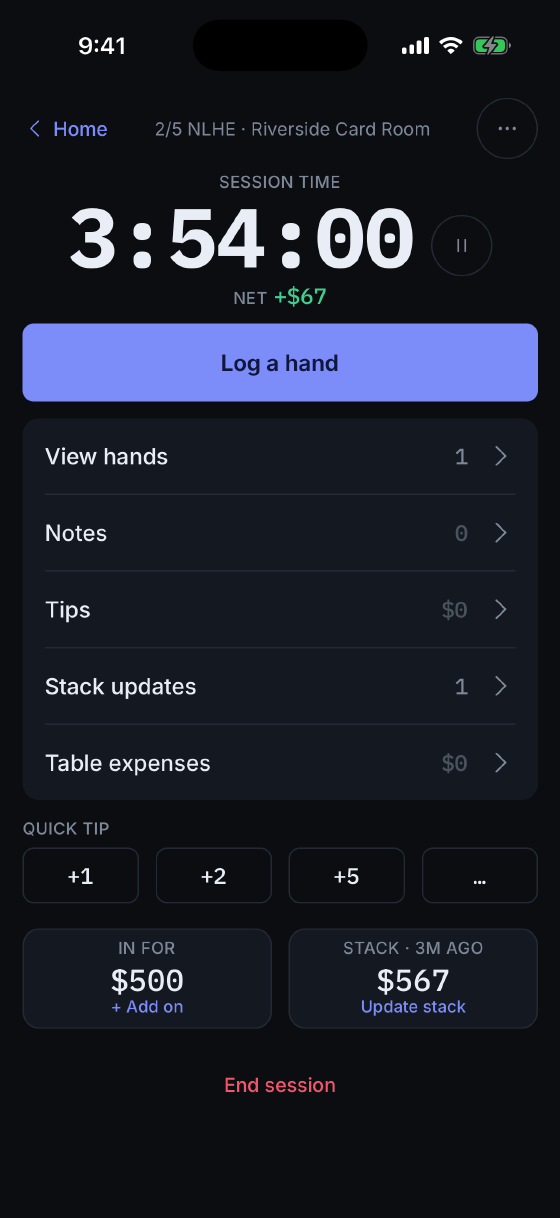
The timer starts itself
You don't have to remember to start it, and you don't have to guess at the end how long you were there.
- 03
Rack up
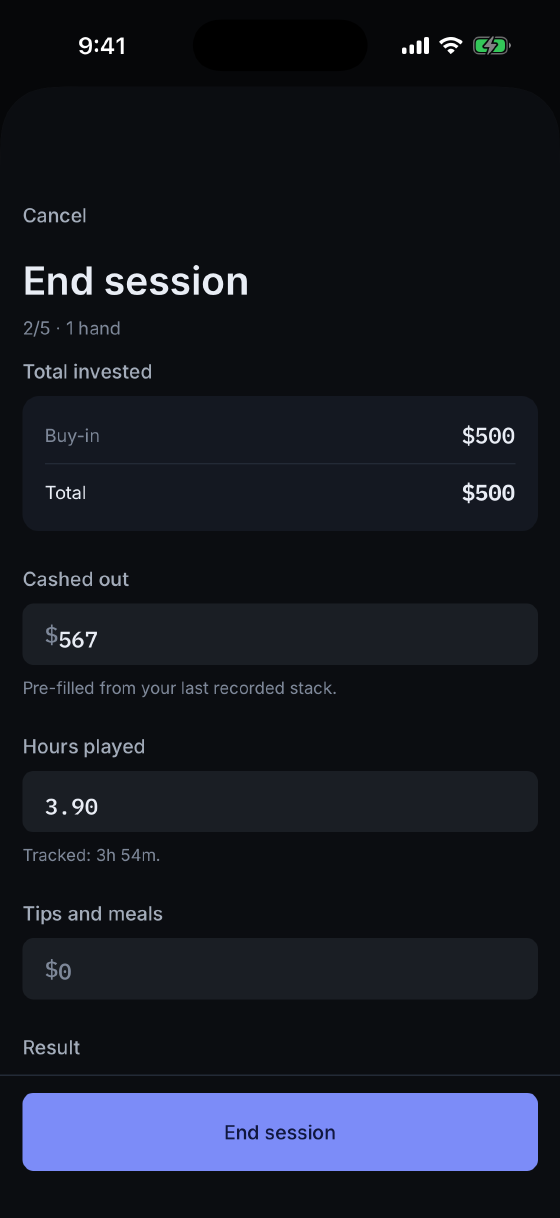
Cash-out, tips if you paid any, and the duration is already there — net of any pauses. Net, $/hour and bb/hour come out the other side.
Forgot to start it? Just record the money
Not every session is one you'll log hands in, and plenty of nights you'll remember the app on the drive home. So recording a finished session is a first-class path, not something buried three screens deep: stakes, buy-in, cash-out, time played, tips. Done.
If you've been keeping your results in a spreadsheet or an app that's stopped being updated, this is the part that will feel familiar — it just doesn't lose anything.
Rebuys are events, not edits
When you top up, that's a thing that happened at a time — not a correction to the number you typed when you sat down. Each one is timestamped, listed with its session-clock time, and editable or deletable afterwards.
Total invested is the buy-in plus every rebuy, and every figure downstream is built on that rather than on whatever you last remembered to type.
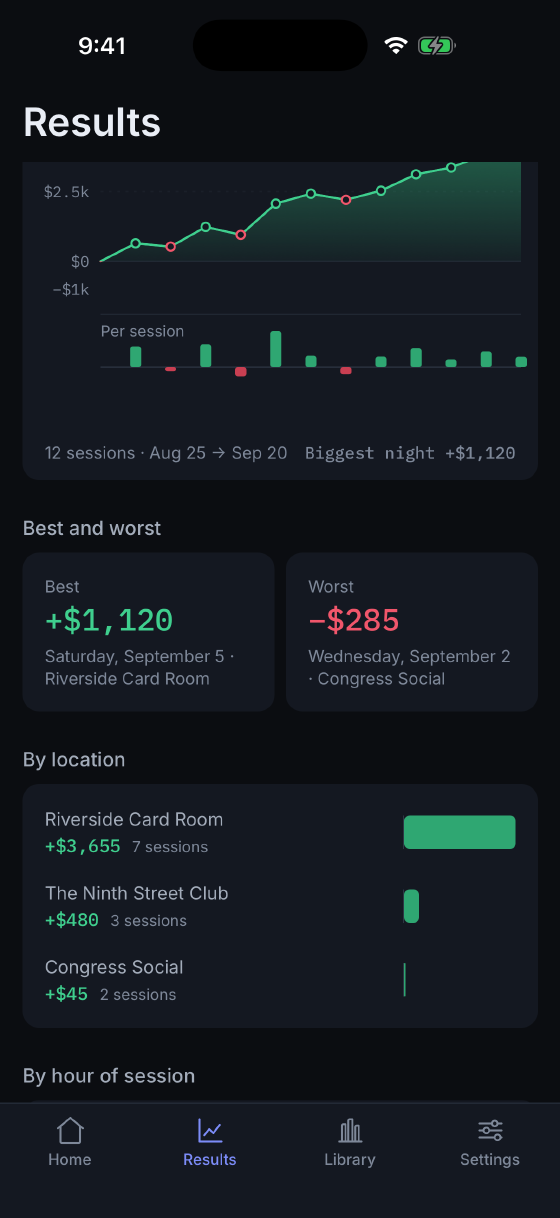
By venue
Which room is actually profitable for you, ordered by how often you play it. The answer is often not the one you'd guess.
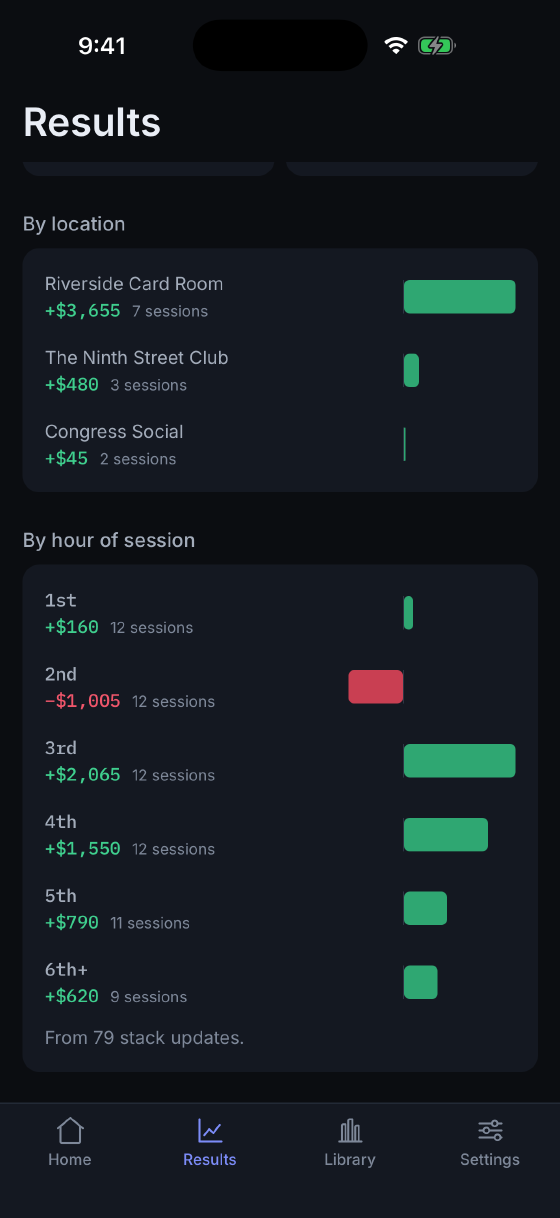
By hour of the sitting
Whether hour seven is paying for hour two. Built from the stack samples you tap in during a session.
By seating position
Net by position across every hand you've logged — with the honest caveat that you log the hands you remember.
bb/hour, not bb/100
Online, a win rate is big blinds per hundred hands, because the software knows exactly how many hands you played. Live, nobody knows. Hands per hour depends on the dealer, the table, and how many people are tanking — so bb/100 can't be computed honestly for a live game, and anyone quoting it to you is estimating.
So Hero Call works in bb/hour, which is a unit a live session actually has. It's a small thing, and it's the kind of small thing that tells you whether a tool was built by someone who plays.
And your history is safe
-
Backed up and synced across your devices.
-
Exportable, free, on every tier — including after you cancel.
-
Nothing is deleted if you stop paying.
The questions people actually ask
Why is this a subscription?
Because it keeps running — syncing, backing up, and being fixed when something breaks. If you stop paying, nothing is deleted. You drop to the free tier, which limits new capture, not access to what you already recorded.
Can I get my data out?
Yes. Free, on every tier, including after you cancel. We will not charge you to retrieve your own records.
Do I have to log hands to use it?
No. Plenty of people only ever track the money, and there's a path to record a finished session in about ten seconds without touching the hand logger.
What if I forget to start it?
Log the session afterwards. Stakes, buy-in, cash-out, time played, tips — it takes seconds and the results maths is identical.
Does it handle more than one currency?
Yes, and it keeps them apart. Currency is a property of a session, so results are segmented by currency rather than converted at some rate that will be wrong by the time you read it.
And when a hand is worth remembering
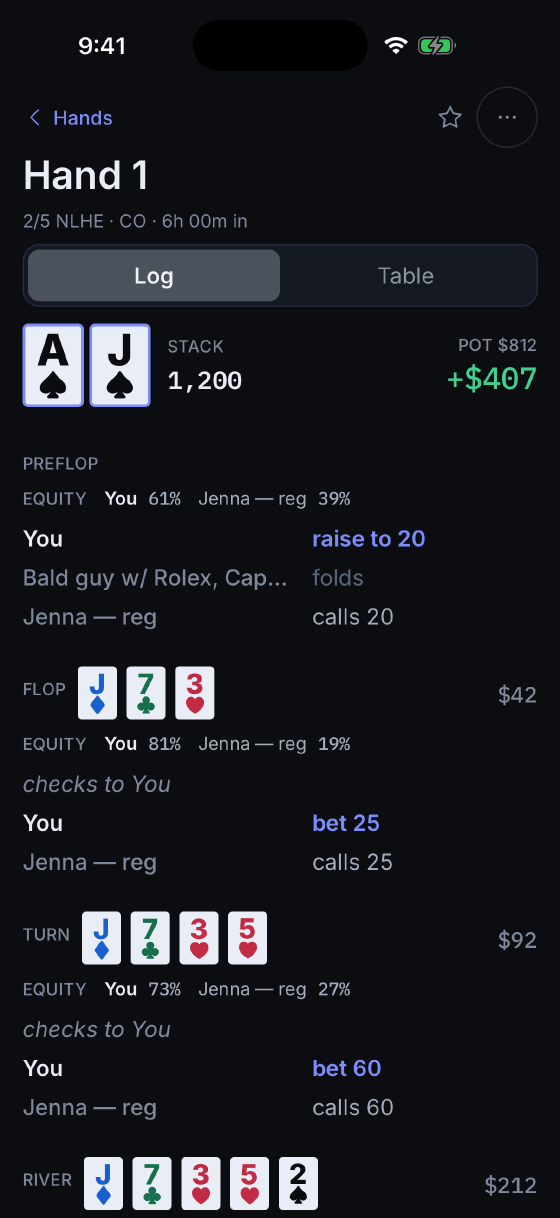
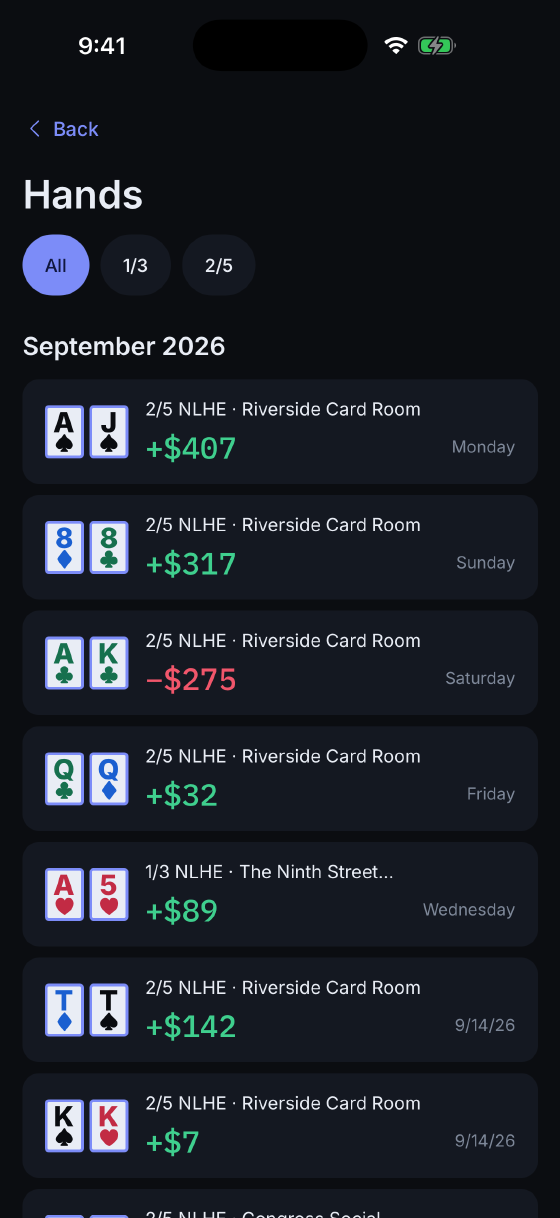
The money is the job you're already doing. The hands are the part you can't do anywhere else — and they live in the same place, so "show me the hands from my worst session" is a question you can actually ask.
Be there when it ships
No launch date yet. We'll email when there's something worth telling you about.